About
The short version: rare disease patient who became an ML scientist who became a community organizer. Still basically doing the same thing I was doing when I discovered Folding@Home as a teenager.
Origin Story
When I was a kid, I found Folding@Home — a program that let you donate your computer’s spare cycles to help scientists understand how proteins fold. I didn’t know what a protein was. I didn’t know what folding meant. I just knew that my computer could help someone figure out something important while I slept. That feeling — that even when you don’t understand the whole picture, you can still be part of the work — never left me.
I studied mathematical quantum field theory. Infinity categories. Topos theory. The kind of math where you spend months with a single proof and come out the other side not sure if you understand more or less than when you started. That’s the part I loved: the gap between the question and the answer, where you have to sit with not knowing. Most people think science is about having answers. I think it’s about getting better at holding the questions.
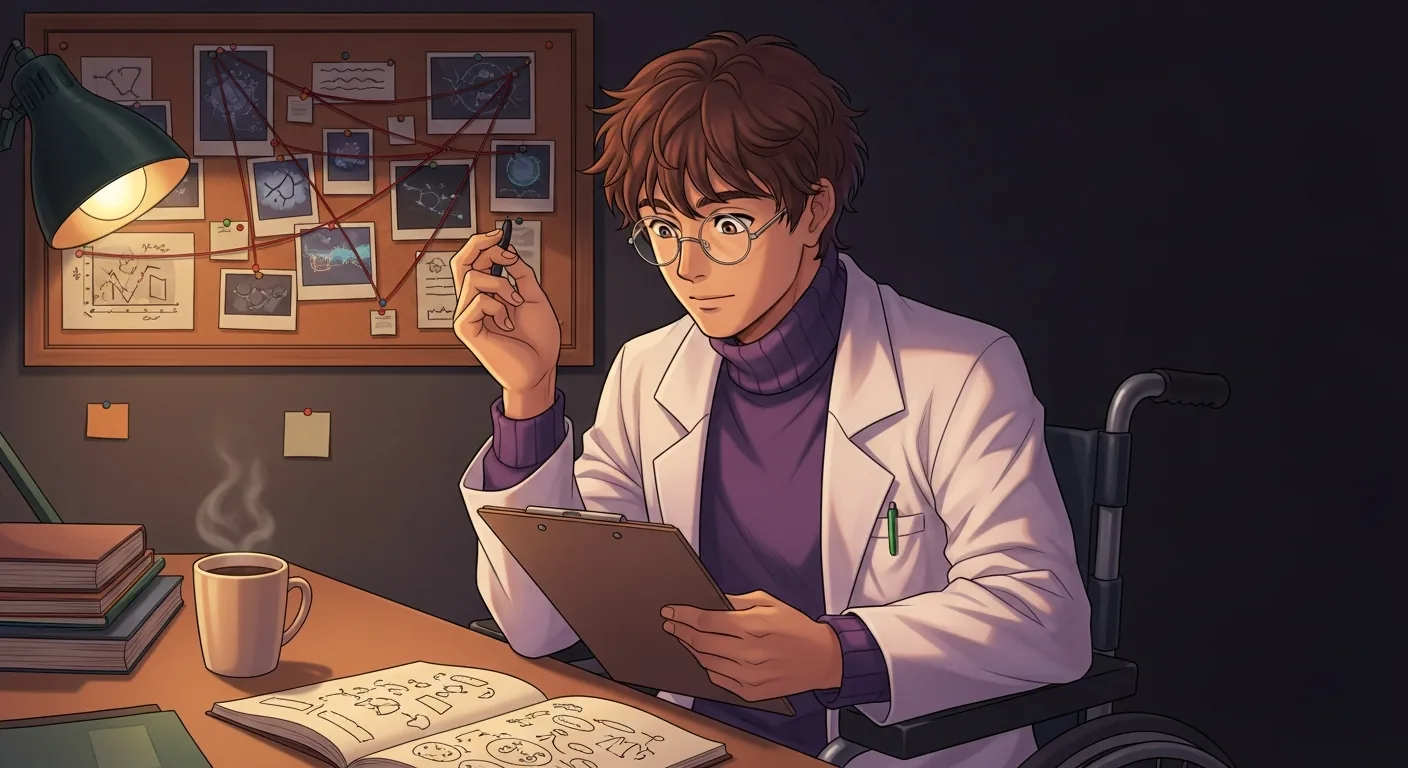
Then I got sick. A rare disease — partially undiagnosed to this day. I lost the use of my hands and feet. I was misdiagnosed more times than I can count. And I watched the healthcare system do something I hadn’t expected: it treated me like a problem it wasn’t designed to solve, and moved on.
That’s when the Folding@Home feeling came back, but sharper: compute could help people. It helped when I was a kid folding proteins on a desktop. It could help now, at a scale and with a precision that mattered for patients like me. I’m still basically doing the same thing I was doing with that Folding@Home wall — getting compute to help people. The scale changed. The mission never did. If that sounds like your problem too, the door at the bottom of this page is open.
That feeling — that even when you don’t understand the whole picture, you can still be part of the work — never left me.
Professional Arc
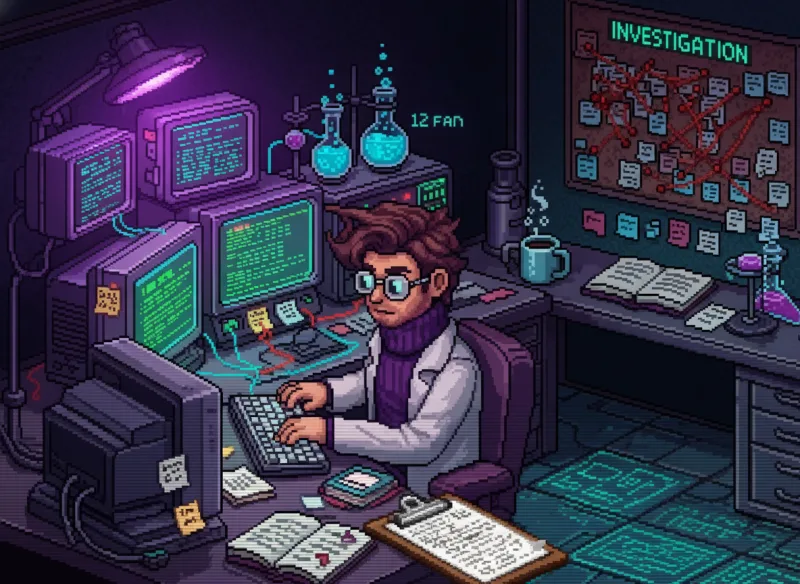
Everyone told me: “What are you going to do with a math degree?” Turns out, tensor algebra gets you hired at Google. I became a Principal ML Scientist, building the Falcon localization system — a platform coordinating fifty thousand translators across more than fifty countries. Imagine Uber, but for translating the entire internet. I watched something alive emerge from the interaction of tools and people at planetary scale.
The realization that never left me: Google built systems this sophisticated to optimize advertising data. Patients like me — years without a diagnosis, navigating fragmented medical systems alone — had nothing remotely comparable. That gap was an open wound. I decided to close it.
I left. Consulted for mission-driven startups, entered the venture deep tech world, found my way back to science through open source and citizen science — not through institutional pipelines. At DeepChem, I mentored PhD students and GSoC contributors in infrastructure and mathematics. At LabDAO, I led the data-science team behind its first community drug-discovery preprint. At VitaDAO, MoleculeDAO, and across the DeSci movement, I helped fund open science — by building communities, not writing grants.
The DeSci chapter taught a hard lesson. A metagenomics pipeline I’d helped build was sold to an oil company. It kind of broke my heart. The tools must be inseparable from the mission they serve. Infrastructure without mission is just technology.
By the time I arrived at Stanford Medicine as an ML scientist, the pieces aligned. The patient perspective, the cybernetic insight, the open science community, and the mathematical foundations. Michael and I designed the Stanford Rare Disease AI Hackathon there — and it proved that a patient, a clinician, and an engineer at one table could find things none of them would find alone.
Lattice Protocol is the operational realization of every stage above. Federated research infrastructure so that compute is never rare for rare disease researchers. So that the next patient navigating a diagnostic odyssey has tools built by someone who understands what that odyssey costs.
In Memory of Michael Brooks
Michael was my best friend and adopted brother. He was also an undiagnosed rare disease patient. We bonded over both having conditions the system couldn’t name — two people navigating the same broken infrastructure, each understanding what the other carried without needing to explain.
Michael told me to stop being ashamed of my story. To be brave. To use what I’d lived through. Without that push, I might never have entered the open science world that became the foundation of everything that followed.
Together, we designed the Stanford Rare Disease AI Hackathon — walking up to physician heroes and asking, “How can I help?” Small squads of engineers, doctors, and scientists tackling problems in days, not years.
Michael passed away from his undiagnosed genetic disease.
In his honor, the community chose action over grief. They partnered with Dell to develop open-source molecular targets. What began as volunteer work driven by love and loss produced real designs: a candidate cardiac peptide for Dr. Michael Levin, a candidate autoimmune binder protein for myasthenia gravis, a design for a novel plastic-degrading enzyme.
Everything I build carries his fingerprints. Not as tribute — as continuation. The infrastructure exists because Michael insisted it should. The mission is his as much as mine.
Credentials
I share these not because titles make the work more valid, but because they help you calibrate what I’ve actually seen and built. The work speaks — the credentials are context.
Current Roles
- Founding Architect — Lattice Protocol (federated AI infrastructure for biomedical research)
- AI-Scientist in Residence — UCLA Venture Accelerator
- Technical Director — The KINN, Venice Beach
Titles are a snapshot; the work moves faster than they do. For what’s actually on the bench right now, see what I’m building now.
Research Partnerships
- Stanford Medicine — Rare disease AI hackathon design and execution
- Undiagnosed Hackathon (Wilhelm Foundation) — hosted at Mayo Clinic; 122 experts, 28 countries, the bell rang seven times (six in the room, a seventh in the months after)
- UCLA Medicine — ML applications in clinical research
- Wilhelm Foundation — Rare disease language model and evaluation toolkit
Previous Roles
- Principal ML Scientist (L7) — Google, Falcon Localization System
- Head of Data Science — LabDAO (open-science drug discovery infrastructure)
- Research Architect — DeepChem (open-source computational chemistry)
- Chief Architect — NewAtlantis Labs (marine AI)
Training
Mathematical quantum field theory — infinity category and topos theory models. The kind of math where you can’t tell if you’re finding something new or proving you’ve been staring at the same object from a different angle. It taught me two things: how to hold complexity without flinching, and how to find the right analogy when the abstraction gets thick.
Speaking & Teaching
Ray Summit, Ai4 Conference, DeSci Podcast, Edge of NFT, Lilypad Network, Cal State Fullerton, Quantum Biology DAO. Weekly Science Sundays at The KINN. Served as GSoC mentor through DeepChem. Twenty years of LA science community building.
Get in Touch
The best science happens through collaboration. Whether you’re a researcher, a patient, a builder, or just curious — the door is open.
science.stanley@stanley.science
GitHub
Open source work, contributions, and issues
Research threads, community updates
YouTube
Science Sundays, tutorials, explainers
Collaboration Areas
- Rare disease research — protein binder design, diagnostic pipelines, patient-led data
- DeSci infrastructure — federated compute, verifiable science, open tooling
- Community building — pod formation, Science Sundays, cross-institutional partnerships
- AI/ML for biology — protein language models, structure prediction, molecular simulation