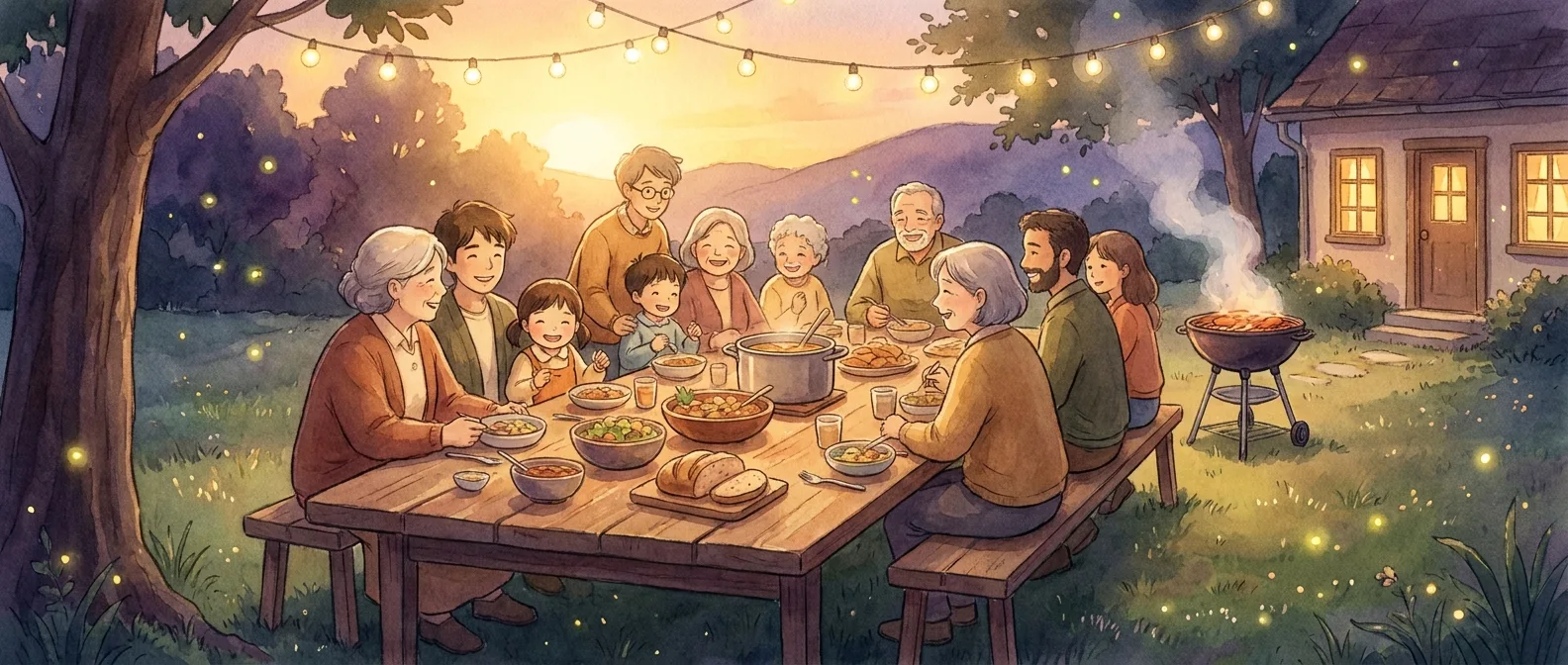
Somewhere right now there is a grill going. There’s corn, and something on a bun, and a cooler of cold drinks, and someone insisting their potato salad recipe is the correct one. It’s the Fourth. And under all of it — under the paper plates and the sparklers and the argument about the potato salad — your body is running one of the most sophisticated chemistry operations on Earth, and you don’t have to think about it even once.
I think that’s worth thinking about.
The Cookout Is a Chemistry Set
Every bite you take is handed off to a crew of molecular machines called enzymes. They’re proteins — folded chains of amino acids — most doing one specialized job apiece, with a precision factories envy. Amylase starts breaking the corn and the bun into sugar before you’ve even swallowed. Proteases take the brisket and the burger apart into their amino acids. Lipase unzips the fats from the butter and the marbling. Thousands of these reactions, all firing in the right order, all so you can go back for seconds.
I’ve written before that proteins are not what you think they are — that they’re self-folding machines, and that changing a single amino acid can rewrite the whole sentence. Enzymes are where that idea gets personal. Because the enzyme reading your cookout tonight was written in your genes, and your genes are the ending of a very long story.
Every Enzyme Is a Winning Dice Roll
Here’s the part I find hard to get over. The instructions for every one of those enzymes were drafted over billions of years, one small change at a time. A gene copies itself and occasionally copies itself imperfectly. Most of those changes did nothing, or made things worse, and got quietly discarded. A few made the enzyme a little better at its job, and those got kept. Mutation deals the cards; survival decides which hands stay in the game.
So the amylase turning your corn into energy isn’t a given. It’s an inheritance — the accumulated luck of every ancestor whose version of that enzyme worked well enough to get them to dinner. When your body handles the cookout without a second thought, it’s cashing in a winning streak that runs back before there were people to have cookouts at all.
For Some, the Dice Landed Differently
And here’s the turn. The same dice that gave most of us working enzymes gave some people a different roll.
Change one letter in the gene for one enzyme, and that enzyme might fold wrong, or never show up at all. We call these inborn errors of metabolism, and they are exactly what they sound like: the body’s chemistry set is missing a tool. They’re individually rare and collectively not — more than a thousand of them exist.
What undoes me is how ordinary the trigger is. A child with PKU is missing the enzyme that processes phenylalanine, an amino acid in nearly every protein — so the hot dog and the burger at that cookout become a careful calculation — a strict, measured diet, managed for life, where the rest of the table just takes a bite. A child with galactosemia can’t break down the sugar in milk, so the ice cream is off the table. A child with MCAD deficiency can’t reliably turn fat into energy while fasting, so a long stretch without food isn’t just a hungry afternoon — it’s something the family watches and plans around.
Same feast. Same shared machinery. One different roll of the dice, and the most normal day of the American summer becomes a thing to navigate.
So — Thank a Rare Disease Patient
Rare disease affects more than 300 million people worldwide — and here in the United States, roughly one in ten of us. The World Economic Forum’s 2026 report Making Rare Diseases Count puts the hidden global cost between 7.2 and 8.6 trillion dollars a year, most of it invisible because the data to see it has never been gathered in one place. That last part matters to me more than the number does. The diagnostic odyssey is, underneath everything, a data problem — and it’s the reason I build what I build.
But today isn’t about the infrastructure. Today is about the people. The patients carrying the rare rolls are the ones who show us how the whole system works — every missing enzyme has taught medicine something true about the enzyme the rest of us take for granted. They hold the edge cases of being human, and they hold them at real cost. And let me be precise about the thank-you: nobody at that table has to be scientifically useful to deserve care — patients are owed their place by being people, full stop. What medicine has learned from every missing enzyme is a gift they gave on top of that, usually while fighting for their own answers. Caring for them isn’t charity, and it isn’t payment for services rendered. It’s what the same genetic lottery that let us eat the cookout without noticing asks of the winners.
So this Fourth of July, somewhere between the second plate and the fireworks: thank a rare disease patient. And if you want to do more than that —
- Learn what it means to live without a diagnosis, and how families are fighting for one, at the Wilhelm Foundation, which works so that everyone living with an undiagnosed disease has the right to an answer.
- Read the WEF’s Making Rare Diseases Count to see why better data is how we turn a shared burden into a shared opportunity.
Happy Fourth. Enjoy the feast. It’s a miracle of chemistry billions of years in the making — and it belongs to everyone at the table, including the ones for whom it’s complicated.
A note on how this was made: this piece was drafted through my agentic context graph — the same voice, accuracy, and visual canon I use for everything here — and every scientific claim was checked by an accuracy audit before it went live, because better data and better tools should always be in service of the people at the table.