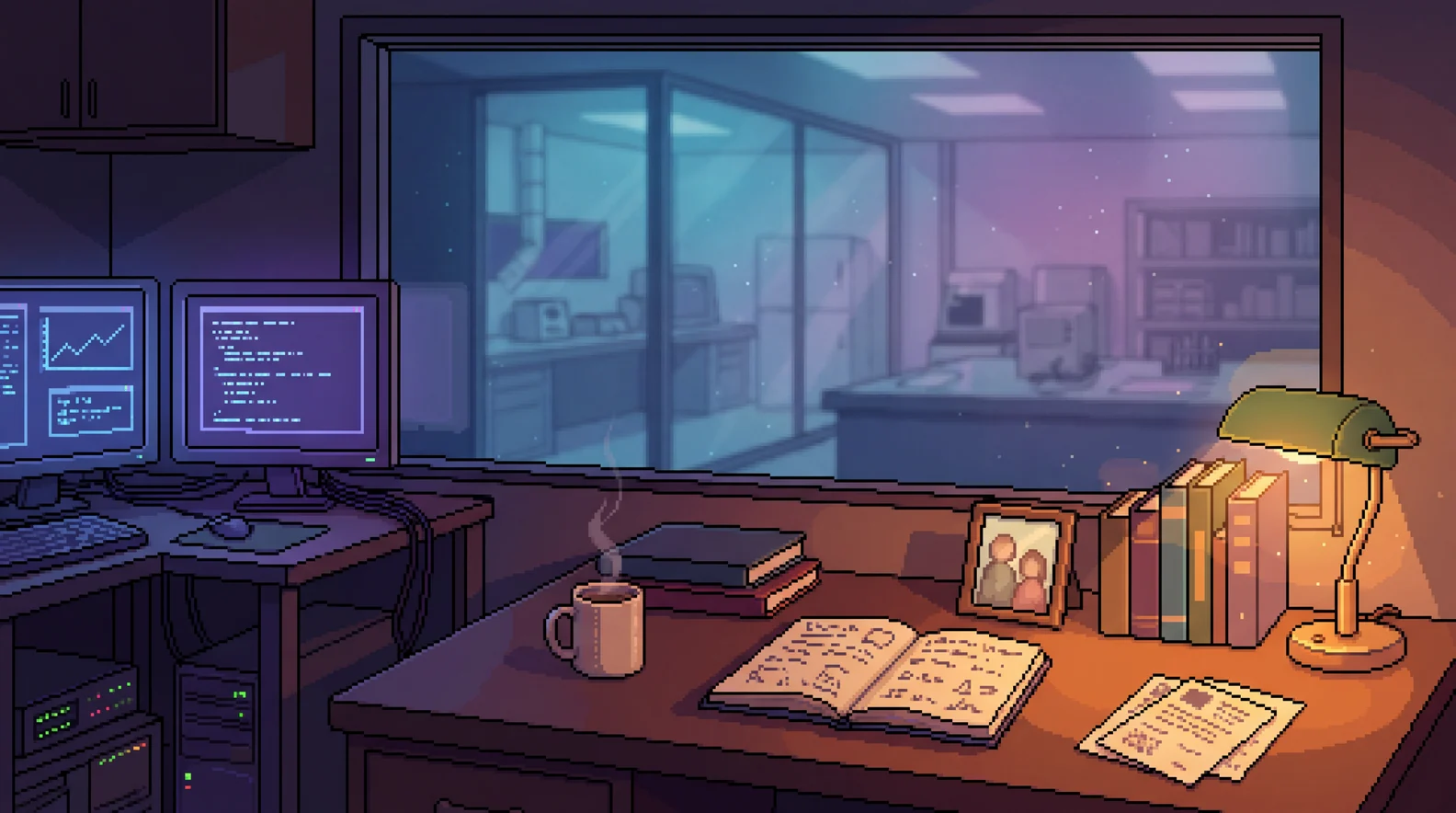
There is a room I have been drawing for months without ever standing in it.
It has a dark wood desk with a lamp pooling amber across it, a mug that has probably gone cold, an open notebook, and a window through to a glass-walled clean lab where the equipment blinks quietly all night.
Zoom in on how that room gets made and it stops being a sketch. It is a file. The file says what has to be true of every picture of the room: warm amber desk lamp against cool blue monitor glow — never one flat light. Dark wood, never metal or glass. Lived-in clutter, never a pristine empty desk. A window through to the lab beyond, never a blank wall. Sixteen-bit pixel art, never photorealism.
None of that is a mood board. It is a contract, and it gets checked before a picture is ever made. Which means the room will be the same room next time — and the time after that.
That room is one of three places.
The lab, the lattice, and the planet
The lab interior is the human-scale one: a desk, a whiteboard with half-erased diagrams, a window. It is where the work actually happens, and it is the only one of the three that feels like a room you could be tired in.
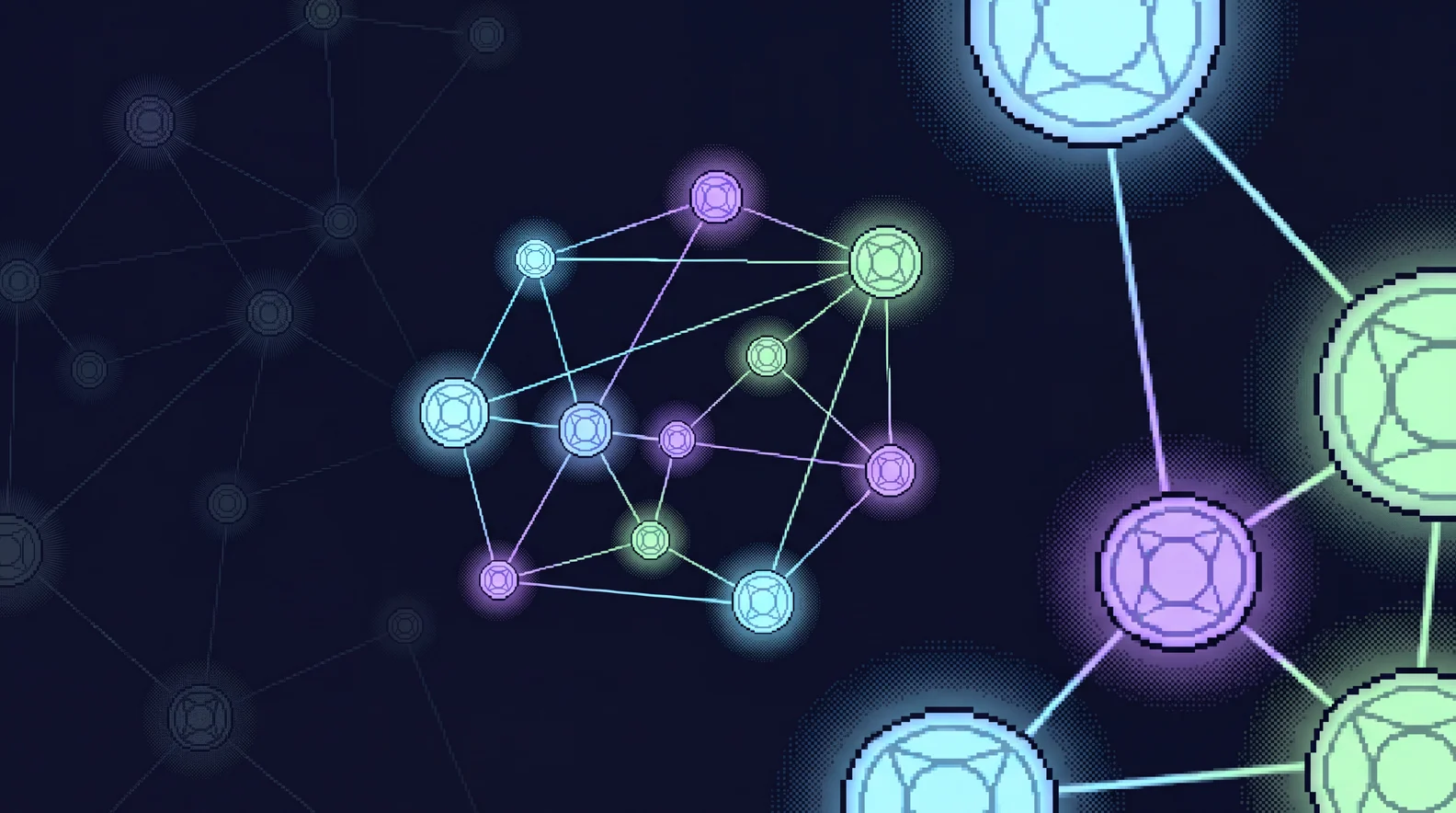
The digital network space is what a lattice looks like from the inside — nodes in a dark void, joined by thin lines, no ground and no horizon. The hard part turned out to be resisting a circuit board. Attempt after attempt reached for PCB traces and gears: a network drawn as the machine that carries it. The specification forbids that by name, and the pictures that broke the rule were the crispest, best-composed ones of the batch. That is exactly what made them the tempting wrong answer.
The global federation is the same idea at planetary scale — labs as small warm compounds on a night-side limb, joined by arcs across the dark. The first round of attempts all came back as the same picture, and it was the wrong one: the corporate globe with swooping arcs that every consulting deck has used since about 2011. The archetype’s own rules had named that failure in advance, and the drawings walked straight into it anyway. The next round escaped it on every try. What finally worked was a handful of compounds in a peer mesh — no centre, no hub, nothing in the middle for the others to orbit.
I want to be careful not to oversell that last detail. The mesh has no centre because the file says it may not have one. That is a decision about drawing before it is a decision about anything else. But it is also the shape I want the thing to have, and it is easier to keep a promise you wrote down first.
One stage, three things standing on it
Here is the part that took me longest to understand, and it is the closest thing this world has to a rule.
All three places sit on the same dark background — one near-black blue, the same value in each. The lab does not get a warmer backdrop because it is the warm one. The void does not get a colder one because it is cold. The stage never changes.
What changes is what stands on it. Warmth comes from a lamp and old wood, not from tinting the room. Cold comes from a clean lab seen through glass, not from a bluer sky. Zoom back out and the three stop looking like three different art styles and start looking like three times of day in one continuous world — which is what they are meant to be, and the reason the difference between them reads as the system working rather than as drift.

The part that is missing, and why it stays missing
All three places are unoccupied.
Not sparsely populated — unoccupied. Nobody lives in these pictures. There is exactly one trace of people anywhere in them, and it is a small framed photograph standing on the desk, holding two figures with no faces. A photograph inside the world, not a character in it. I like that it is there. An empty room with a photo on the desk is a different kind of empty than a room that never had anyone.
Because the plan for this world has always been that it is populated by real scientists and research leaders — appearing as characters, together with their actual work. Real, living, named people. Which means the next step is not a drawing problem at all. It is asking someone whether they would like to be in it; being able to say precisely what they would be agreeing to; and being able to take it back later without a fuss.
There is a written policy for how that has to go. What there isn’t yet is a first name on it. Until there is, drawing anybody would be answering a question on their behalf — and the entire point of asking is that the answer isn’t mine.
So: three rooms, furnished, lit, and nobody home.
It is a slightly strange thing to publish. But a room you can look into is more honest than a crowd I invented, and it means that when someone does say yes, there is already somewhere for them to be.
The lamp is on. The mug is still warm. Come back for the people.