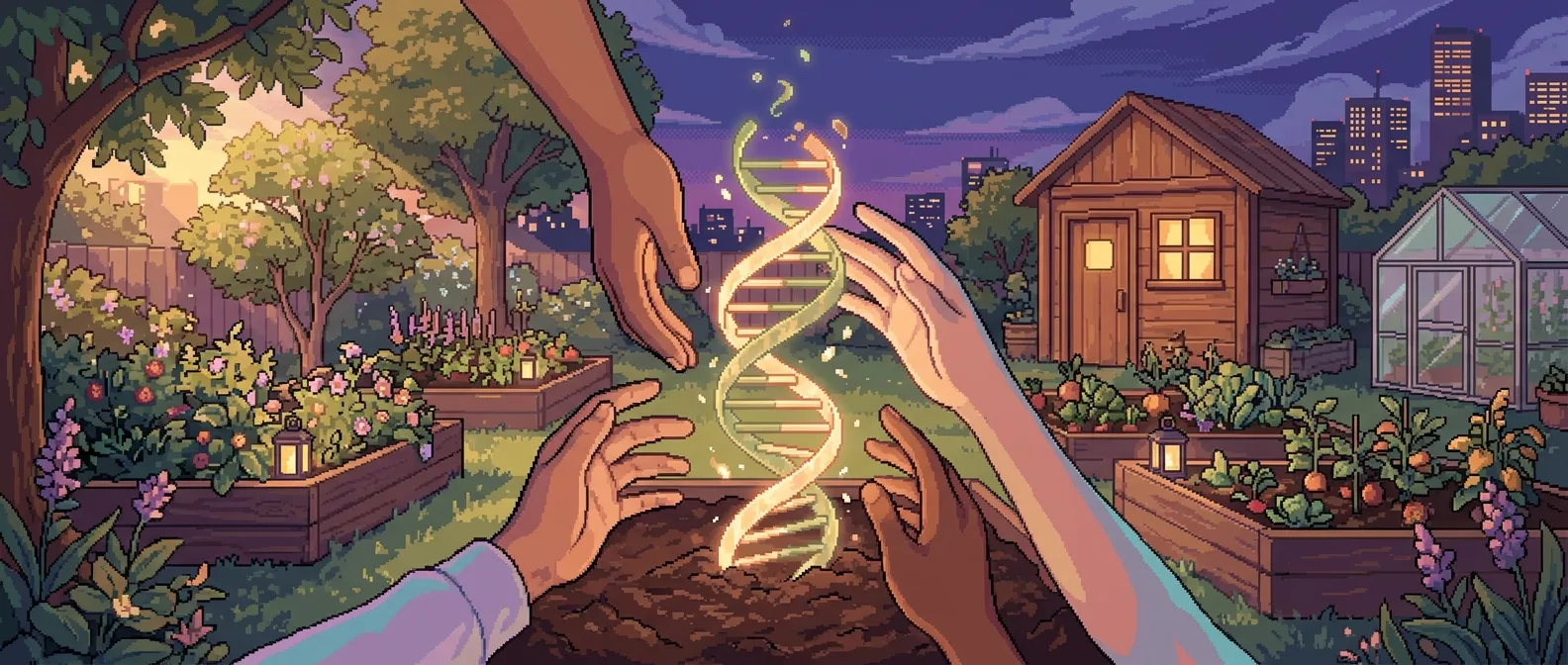
A teenager in a Ventura County classroom scoops a gram of soil from the school garden, loads it into a sequencer the size of a stapler, and reads the genetic signatures of tens of thousands of species that were living under her feet — a feat like tipping ten thousand jigsaw puzzles into a blender and then sorting every piece, one by one, back into its own finished picture. Then comes a question almost nobody asks until it is too late: who owns that data?
The school? The company that built the sequencer? The student? The organisms themselves?
It sounds like a seminar question. It is actually an engineering decision — and most platforms make it by avoiding it. The data flows uphill to whoever owns the servers, and the people who generated it learn, much later, that they were the product. Citizen science has a quiet habit of borrowing communities’ labor and keeping the results.
The World Genome Academy is being built to make the opposite choice, and to make it structurally — in the architecture, not the fine print.
Not a company, and not a DAO
The plan is a multi-stakeholder cooperative trust. Not a corporation that owns the data and rents access. Not a token economy that turns governance into a market. A governed commons, where the schools, farms, tribal communities, and research labs that generate environmental genomic data also own it, govern it, and share in what it produces.
The trust is designed, not yet incorporated — this is architecture in progress, and I would rather describe it honestly than pretend the paperwork is filed. But the shape is deliberate. Five constituent councils — Education, Agriculture, Research, Indigenous, and Technology — are each meant to carry real voting authority over the policies that touch their domain.
A veto that means no
The Indigenous Council is designed to hold genuine veto power over data policies affecting tribal lands and knowledge. Not a comment period. Not a seat at a table where the decision has already been made. The authority to say no, and have the no hold.
That distinction is the whole point. Most “community input” in research is consultation: we will listen, and then we will do what we planned. Structural authority is different. It changes who has to be convinced before anything moves. When you build the veto into the governance instead of into goodwill, it survives the next funding cycle and the next change of leadership.
Sovereignty you can audit
Underneath the councils sits the part engineers will care about. Data governance here is meant to be technically enforced, not merely promised. The design pairs FAIR principles — findable, accessible, interoperable, reusable — with CARE: collective benefit, authority to control, responsibility, ethics. FAIR makes data useful. CARE keeps usefulness from curdling into extraction.
Enforcement is designed to run on a distributed ledger — a permissioned Hyperledger Fabric layer for governance, with a public audit trail on Arbitrum. The intent is that a data-use rule becomes something a program checks, on-chain, rather than a clause someone hopes you read. Collective benefit stops being a slogan and becomes a design principle with teeth: who may use a dataset, and under what conditions, is enforced by the system that stores it.
Why this is the hard version
The easy version of citizen science hands people a kit and collects their results. The hard version hands people the kit and the authority — and then has to live with what they decide.
It is harder because shared governance is slower than a server you control. It is harder because a real veto can stop your roadmap. But the easy version keeps reproducing the thing it claims to fix: communities do the work, institutions keep the value. Communities already hold authority over the life in their own soil and water. Good infrastructure does not grant that authority. It recognizes it, and refuses to route around it.
So: when a 14-year-old sequences the DNA in her school garden, who owns the data? The answer we are building toward is the one that was true the whole time. She does — together with the community she is part of. The work is making the systems behave as if that were so.