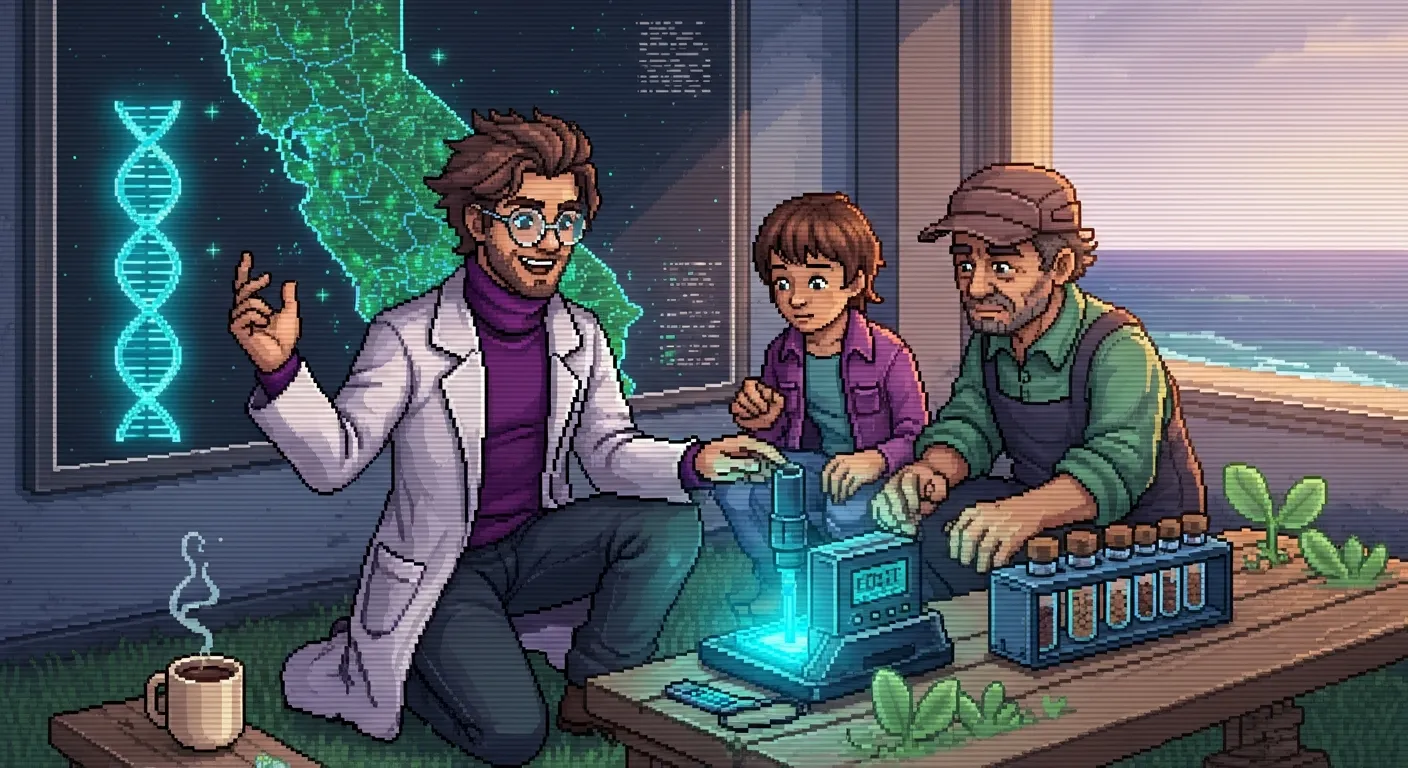
WGA — World Genome Academy
Federated citizen science platform putting portable DNA sequencers in the hands of K-12 students and farmers, generating GIS-indexed metagenomic data about California’s environments.
One gram of soil contains tens of thousands of microbial species. A single water sample from the California coast carries an invisible census of every organism that passed through it. The problem has never been that we can’t read these signals — it’s that the tools to read them have been locked inside institutions that most people will never enter. WGA changes the denominator.
The World Genome Academy puts Oxford Nanopore MinION sequencers — palm-sized, USB-C, real-time DNA readers costing roughly $1,000 — into the hands of high school students and regenerative farmers. Five interconnected systems make up the platform’s design: a WASC-compliant K-12 curriculum built around eDNA metagenomics, soil microbiome monitoring for agriculture and carbon credit verification, coastal and kelp forest surveys connected to global ocean biodiversity networks, the California eDNA Atlas (planned as a living, queryable map of the state’s invisible biological web), and a multi-stakeholder cooperative trust designed so the communities generating data also govern how it’s shared.
The governance model is the part that matters most. In the design, FAIR + CARE principles aren’t just policy language — they’re technically enforced through a distributed ledger layer. Students won’t just pipette samples and run basecalls. They’ll sit on constituent councils alongside farmers, researchers, and Indigenous data sovereignty advocates, making real decisions about who benefits from the data they generate. That’s not a field trip. That’s infrastructure.
WGA grew from IMAC (the International Marine AI Consortium), my earlier open-source initiative for AI-powered ocean biomonitoring. Where IMAC focused on building AI tools for marine science, WGA widens the aperture: land and sea, education and agriculture, local data and federated governance. California first — because it’s the nation’s top agricultural state, has about 840 miles of coastline, and already has the policy infrastructure (CDFA Healthy Soils, California Climate Investments, Strong Workforce Program) to support this kind of work. Federation handles the rest.
There’s an artistic arm to all of this, and it might be my favorite part. The same eDNA readings that map a kelp forest can be turned into sound — each organism a voice, a whole reef a piece of music. The World Genome Symphony is being designed to do exactly that: to let a coastline’s health stop being a spreadsheet and start being something you can hear. It’s still on the drawing board — no notes have been performed yet — but the plan is a first public performance in the summer of 2027, out on the sand at Venice Beach. I wrote about why we’d bother making biology audible in What If DNA Could Sing?.
I made the short version of this argument on a TEDx stage in Venice — Grassroots Genomics, eight minutes on why the ocean needs measuring in real time and what changes when the instrument fits in a student’s backpack.
If you want the longer versions of the rest, The Invisible Web Under Your Feet is the case for putting research-grade sequencers in a high schooler’s hands, and Who Owns the Data? is the harder question of who governs what all those samples reveal. Those two — the wonder and the stewardship — are the whole project in miniature.